
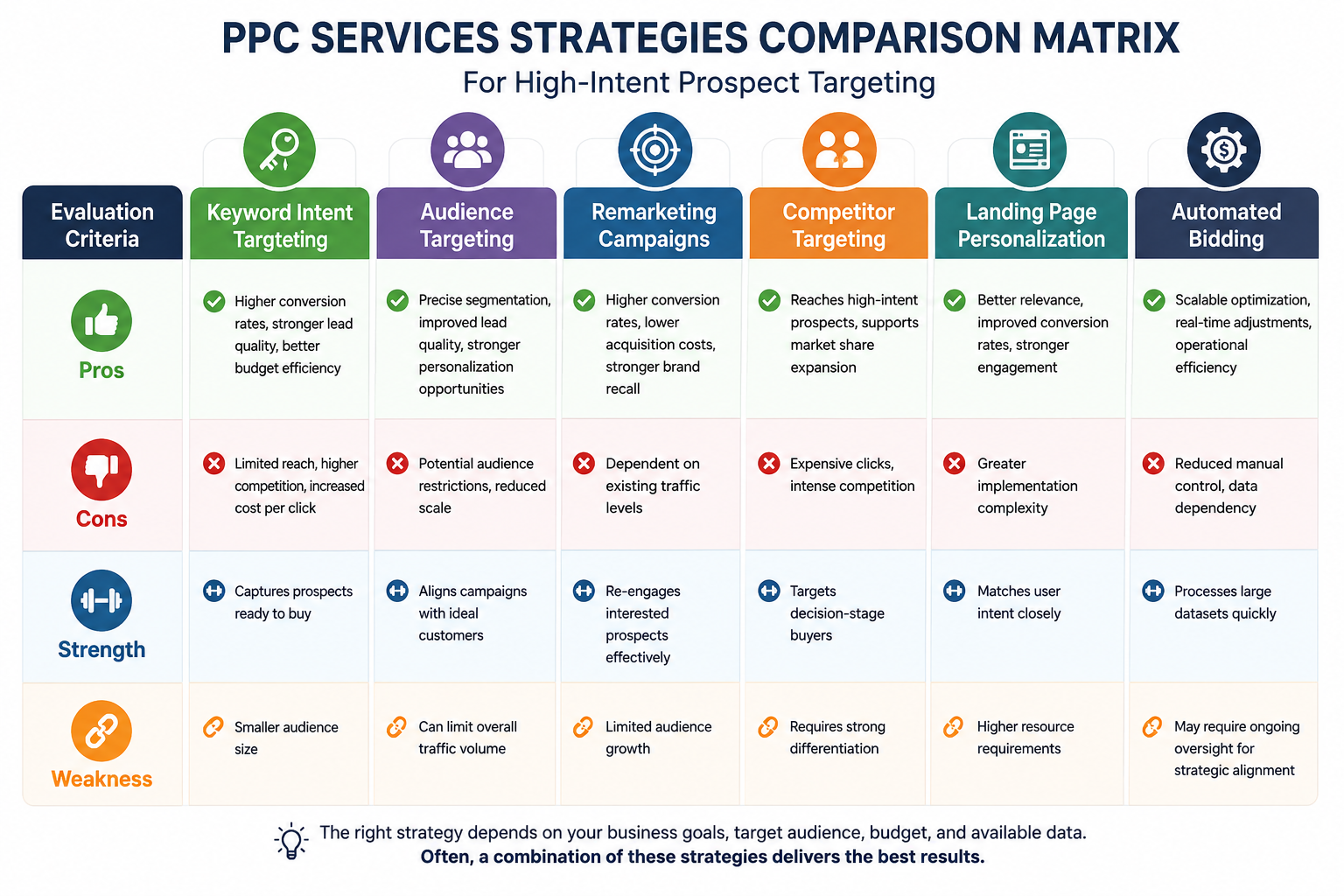
Businesses investing in PPC services are increasingly focused on attracting prospects who are ready to take action rather than generating large volumes of low-quality traffic. High-intent targeting helps advertisers maximize budget efficiency, improve conversion rates and shorten the sales cycle. However, different targeting approaches offer unique advantages and trade-offs. Understanding how each strategy performs can help marketers allocate resources more effectively and generate stronger returns from paid advertising campaigns.
Keyword Intent Targeting vs. Broad Reach Campaigns
One of the most common approaches in PPC services is targeting keywords that indicate strong buying intent. Search terms such as “best SEO agency near me,” “enterprise PPC management pricing” or “digital marketing consultation” often signal that a user is close to making a decision.
The primary advantage of intent-based keyword targeting is efficiency. Advertisers spend money on users who are actively researching solutions and are more likely to convert. This often results in lower acquisition costs and higher conversion rates.
The downside is limited reach. High-intent keywords typically have lower search volume and higher competition, which can drive up cost per click. Broad campaigns generate greater visibility but often attract visitors who are still in the research phase and not yet ready to buy.
Audience Targeting vs. Search-Only Targeting
Audience targeting allows advertisers to reach users based on behaviors, demographics, interests and previous online activity. Platforms such as Google Ads and LinkedIn provide detailed audience segmentation options that help marketers narrow their focus.
According to Matt Bowman of Thrive Agency, combining audience intelligence with keyword intent creates stronger campaign performance because marketers can reach prospects who not only search for relevant solutions but also fit the ideal customer profile. This layered approach often improves lead quality and sales opportunities.
The advantage of audience targeting is precision. Advertisers can prioritize decision-makers, specific industries or users who have demonstrated relevant behaviors. However, overly restrictive audience filters may reduce traffic volume and limit campaign scalability. Search-only targeting offers broader exposure but may attract users outside the ideal customer profile.
Remarketing Campaigns vs. First-Time Visitor Campaigns
Remarketing focuses on users who have already interacted with a website, landing page or previous advertisement. Since these prospects are familiar with the brand, they often convert at higher rates than completely new visitors.
The strongest benefit of remarketing is improved conversion efficiency. Businesses can re-engage users who abandoned forms, viewed service pages or interacted with important content. These prospects typically require less persuasion than first-time visitors.
However, remarketing audiences are limited by website traffic volume. Businesses with lower traffic may struggle to generate enough audience size for meaningful results. First-time visitor campaigns help fill the pipeline with new opportunities but generally produce lower conversion rates because prospects have not yet established familiarity with the brand.
Competitor Targeting vs. Category Targeting
Competitor targeting involves bidding on keywords associated with competing companies or creating campaigns designed to attract users evaluating alternative providers. Category targeting focuses on broader industry-related searches rather than specific competitors.
Competitor targeting can generate highly qualified traffic because users are often in the final stages of evaluation. These prospects may already understand the service category and simply need to choose between providers. For many businesses, this creates valuable opportunities to win market share.
The drawback is higher advertising costs and stronger competitive pressure. Competitor keywords frequently command premium bids, and conversion success depends heavily on differentiating the offer. Category targeting generally provides more volume and flexibility but may include users at earlier stages of the buyer journey.
Landing Page Personalization vs. Standard Landing Pages
Even the most effective targeting strategy can fail if the landing page experience does not align with user expectations. Personalized landing pages adapt messaging, offers and calls to action based on audience segments or keyword themes.
The advantage of personalization is relevance. When visitors see content that directly addresses their needs, they are more likely to engage and convert. Personalized experiences often improve quality scores, reduce bounce rates and increase lead generation performance.
The challenge is complexity. Personalized campaigns require additional development resources, ongoing testing and more sophisticated campaign management. Standard landing pages are easier to maintain and deploy but may fail to address the specific concerns of different audience segments, resulting in lower conversion performance.
Automated Bidding vs. Manual Bid Management
Modern advertising platforms increasingly encourage advertisers to use automated bidding strategies powered by machine learning. These systems adjust bids in real time based on user signals and conversion likelihood.
Automated bidding offers scalability and efficiency. Campaigns can process vast amounts of data faster than manual management, helping advertisers identify valuable opportunities and optimize performance continuously.
The trade-off is reduced control. Automated systems may require significant conversion data before achieving optimal results and can sometimes make adjustments that conflict with business priorities. Manual bidding provides greater transparency and strategic oversight but requires more time, expertise and ongoing monitoring to remain competitive.